Dental Assistant Billing and Coding: What Students Should Learn
Learn how chairside assisting differs from scheduling, insurance, billing, and coding, and use practical questions to compare dental assistant training.

Understanding dental assistant billing and coding starts with separating tasks that may overlap in a dental office but are not interchangeable. Chairside care, scheduling, insurance verification, claims, billing, and code selection can belong to different team members. If you are comparing training programs, ask what the curriculum actually teaches and what it does not promise.
What does a dental assistant do at chairside?
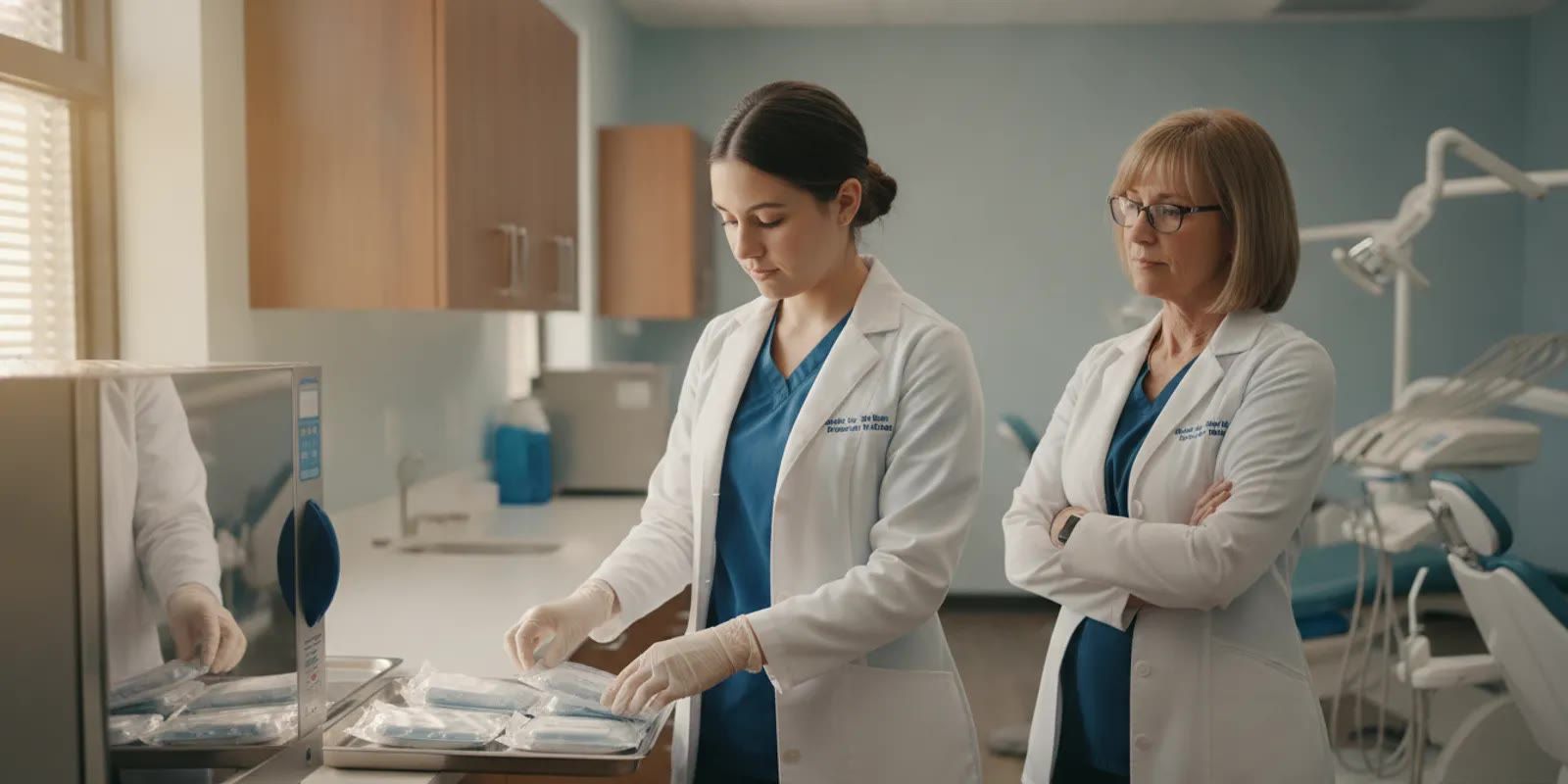
Chairside assisting supports the dentist during patient care. An assistant may prepare instruments and materials, organize the work area, use suction as directed, pass instruments, and help prepare a room between appointments. The dentist makes clinical decisions. Duties an assistant may perform depend on applicable rules, preparation, and the dentist’s direction.
Training for this work can cover infection prevention, sterilization, dental materials, impressions, temporary restorations, radiography topics, and emergency response. These subjects are distinct from deciding what treatment a patient needs. Ask whether hands-on practice is part of a course, which skills students practice, and how instruction is supervised.
A chairside task may still connect to office records. For example, a team member may help ensure that information from a visit is passed to the person responsible for documentation or claims. That handoff does not mean the assistant independently diagnoses the patient, decides what a payer should cover, or chooses a code based on an assumption.
How are scheduling and front-office work different?
Scheduling coordinates appointments, calendars, reminders, and changes. Front-office staff may also greet patients, route calls, collect forms, and help the day run smoothly. In some practices, assistants contribute to scheduling or communicate timing between front and clinical areas. That does not mean every assistant has front-desk duties or that every office divides work the same way.
Scheduling may involve appointment length, clinician availability, room or equipment needs, and a patient’s requested time. A training program may introduce office operations, but students should not assume a short course qualifies them for every administrative responsibility. Ask how much instruction is devoted to office workflows versus clinical practice, and whether scheduling is demonstrated, practiced, or outside the curriculum.
It can help to think through a simple handoff. A front-office employee books a visit and records the appointment details. The clinical team then prepares for the scheduled care. If the visit length or service changes, the team follows its process for communicating that change. The person who updates the calendar is not thereby responsible for clinical decisions or insurance coding.
What happens during insurance workflows?
Insurance work may include checking eligibility information, gathering details for a claim, documenting services, and communicating with a payer or patient about a submission’s status. These steps are administrative. Coverage rules vary by plan, and an eligibility check or estimate is not a guarantee that a payer will cover a service or pay a particular amount.
Dental teams may split this work among a treatment coordinator, billing specialist, receptionist, or other staff. An assistant might help ensure chart information is complete or pass information to the person handling claims. That is different from making coverage promises. Students should distinguish recording information from interpreting a policy or making a financial commitment for an office.
For example, a patient may ask whether a proposed service is covered. A staff member can follow the office’s process to check available plan information and explain that the result is not a payment guarantee. Questions about clinical necessity should go to the clinician; questions about plan terms or account estimates should go to the authorized staff member handling those matters. Clear routing is more useful than guessing.
What do billing and coding mean?
Billing is the process of preparing and tracking charges and payments. It can involve organizing documentation, submitting claims, recording remittances, following up on unpaid items, and explaining account information within office policies. Coding means assigning standardized codes to documented services and conditions for reporting or payment processes. A code must reflect the record and applicable guidance; it is not a substitute for a clinician’s diagnosis.
These functions require careful handling of information. Incorrect or incomplete details can lead to questions, delays, or corrections. Staff should follow office procedures, use only authorized access, and seek clarification when documentation is unclear. A new assistant should not infer a diagnosis, alter a clinical record, or choose a code merely to make a claim more likely to be paid. When information does not match, ask the responsible clinician or trained billing staff member to clarify the record.
Privacy also matters whenever someone handles patient records. Avoid discussing identifiable information in public areas, sharing logins, or opening records without a work-related reason and authorization. Follow the employer’s training and procedures. The U.S. Department of Health and Human Services is a government source for information about health privacy and related topics; students should use the guidance and procedures that apply to their role and workplace.
How does a patient visit move through these roles?
Consider a routine appointment. Before the visit, a front-office team member may schedule the time and gather administrative details. The clinical team prepares the room and supports the dentist during care. The dentist makes and documents clinical decisions. Afterward, authorized staff use the documentation to prepare any necessary claim, track its status, and answer account questions within office policy. The sequence varies, but each handoff should preserve accurate information.
Suppose the planned service changes during the appointment. The clinical record and any administrative follow-up may need review. A staff member should not quietly substitute a code based on an assumption or promise that a plan will pay. Confirm what was documented, route clinical questions to the clinician, and send coverage or claim questions to the person responsible for them.
In a small practice, one employee may have several administrative and clinical tasks. In a larger office, duties may be more specialized. The job title alone does not tell a student what a future employer will assign. Training provides foundational knowledge; workplace procedures, applicable rules, and a worker’s preparation shape the actual role.
Where do responsibilities overlap, and where are the boundaries?
A single visit can touch several roles. An assistant may prepare the room and support care; the clinical team documents what happened; front-office staff manage appointment and account processes; and billing staff may prepare a claim from the record. Smaller offices may assign some administrative tasks to people who also do other work. Larger offices may separate these responsibilities.
Overlap does not erase boundaries. The person entering or transmitting information should have authorization and training for that task. Clinical decisions belong to qualified clinicians, and office staff should rely on documented information rather than assumptions. If a request falls outside your preparation, ask a supervisor who owns the task, what documentation is needed, and how to escalate an unclear record. Do not guess.
For a student, a useful way to test a task is to ask three questions: Is this a clinical decision, an administrative step, or a handoff? What training and authorization does the task require? Who should answer if the information is incomplete? This simple check can keep related activities from being treated as though they were identical.
What should students ask when comparing programs?
Ask for specific answers rather than relying on broad phrases such as “office skills” or “career ready.” Request written details and compare the stated curriculum to the work you hope to learn:
- Which topics are actually taught? Ask for a list separating chairside skills, scheduling, insurance processes, billing, and coding.
- What does “coding” mean in this course? Clarify whether it is an overview, guided exercises, or substantial separate study. Ask how students are assessed.
- How much practice is included? Ask what students practice, in what setting, with what materials, and how instruction is supervised.
- Is a separate credential included? Request the exact name and issuer of any credential. Do not assume dental assistant training includes a billing-and-coding credential.
- Which records or systems are covered? Ask whether the course teaches general recordkeeping concepts, a particular software workflow, or neither. A guide to dental practice software for assistants can help you frame questions about charting and office systems.
- What are the course’s limits? Ask which duties are not taught and whether the program makes any specific claim about eligibility for administrative positions.
- What are the schedule and full costs? Request current written details about dates, attendance, fees, and additional expenses. When reviewing costs, use a written itemized explanation rather than comparing only a reservation fee; see these questions to ask about dental assistant program costs.
- Who can clarify an unclear answer? Find out whom to contact about curriculum, externship, or award descriptions, and request clarification before deciding.
How should you compare clinical training with billing-and-coding study?
A dental assistant program and a dedicated billing-and-coding course may serve different learning goals. Compare their actual content, not just their titles. Clinical-assisting study may emphasize chairside routines, infection prevention, radiography topics, dental materials, and supervised practice. A billing-and-coding course, if offered separately, may spend more time on claims, payer processes, code references, documentation exercises, and account workflows. Do not assume either course includes the other’s full curriculum.
Make a side-by-side checklist of skills you want, and label each “covered,” “introduced,” or “not listed,” based on written materials or a direct answer from admissions. Then ask how each skill is practiced and assessed. For example, “charting” could mean learning how clinical notes are organized; it does not automatically mean students practice coding claims. Definitions make comparisons more useful.
Also separate curriculum content from credential eligibility. A program may introduce a topic without preparing a student for every task in a specialized job. If a school mentions an award, ask for its exact name, issuer, requirements, and the skills it represents. Verify whether it is included in the course or requires separate study. Do not treat a general dental assistant training program as a billing-and-coding credential unless the school confirms that specific credential in writing.
What does Alliance Dental Institute describe in its training?
Alliance Dental Institute describes an in-person dental assistant training program in Villa Rica, Georgia, combining classroom instruction with practical dental-office learning and a stated 40-hour externship. Published topics include chairside assisting, radiography, sterilization, charting with Dentrix or Eaglesoft, dental materials, emergency response and CPR, and career preparation. These details describe dental-assisting training, not a separately verified billing-and-coding credential.
Prospective students interested specifically in claims administration should ask admissions whether billing or coding topics are included and how they are covered. Ask for the current subject list and clarification of what charting or office-workflow instruction includes. Do not infer from software or charting exposure that a course includes a full coding curriculum or qualifies a student for a separate credential.
Program details can change. Confirm current curriculum, schedule, fees, and award details with the school before deciding. The school describes in-person instruction at its Villa Rica campus; prospective students should verify that the attendance arrangement works for them.
Frequently asked questions
Does every dental assistant handle billing and coding?
No. Duties vary by office, employer, training, and applicable rules. Some assistants may help with documentation or administrative handoffs, while other staff handle claims and account follow-up.
Is coding the same as diagnosing a patient?
No. Coding reports documented information in a structured format. It does not authorize administrative staff to diagnose or make treatment decisions.
Does dental assistant training always include a coding credential?
No. Do not infer a separate credential from a program’s general dental assistant title. Ask for the exact credential name, issuing organization, and curriculum details in writing.
Can insurance verification guarantee payment?
No. Verification provides information about a plan but does not guarantee coverage or payment. Final decisions depend on plan terms and the information submitted.
Call admissions with your curriculum questions
When comparing options, match the written curriculum to the work you hope to do, and confirm responsibilities and requirements with the prospective employer or training provider.