Dental Assistant vs Dental Receptionist
Dental assistant vs dental receptionist: compare chairside support, scheduling, charting, software, and Georgia rules before you choose training.

A dental assistant vs dental receptionist search usually starts with one practical question: do you want to work beside the dentist. Or do you want to run the front of the office? Both people talk with patients, use office software, and keep the day moving. They do not spend the day on the same work, and they do not train for the same skills.
A dental receptionist greets people, answers the phone, schedules visits, and handles much of the paperwork. A dental assistant prepares the room, supports the dentist during care, and learns clinical tasks such as sterilization, charting, and radiographs. In Georgia, clinical tasks stay under a licensed dentist's direct supervision. Neither title is a promise of a job, a wage, or a license.
Contact Alliance Dental Institute to ask about the 12-week in-person dental assistant program in Villa Rica.
Where the dental assistant vs dental receptionist day happens
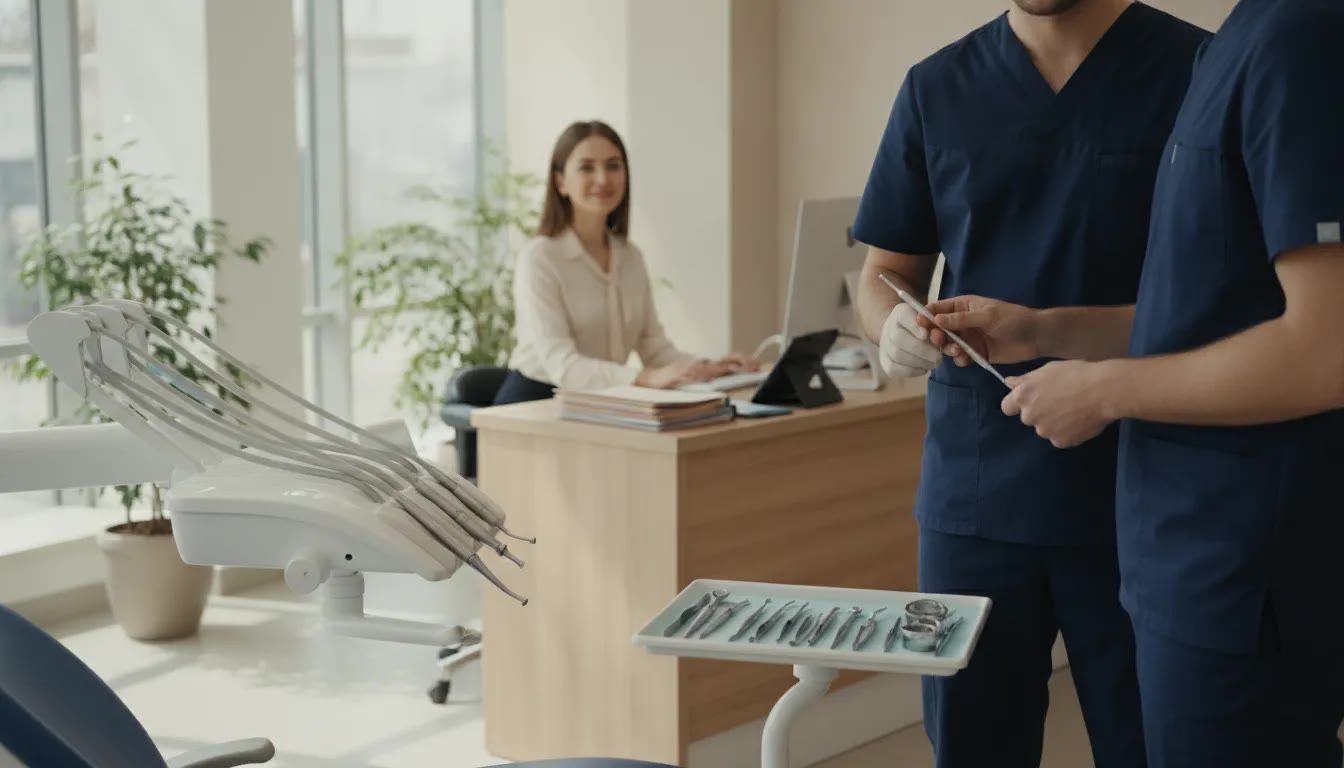
The simplest split is the room. The receptionist works at the front desk. The dental assistant works in the treatment area, then moves between rooms, sterilization, and the computer used for the chart.
On a typical morning, the receptionist opens the schedule, confirms who is coming in, and watches the waiting room. The dental assistant sets up the first operatory, checks that instruments are ready, and stays with the dentist once the patient is seated. When a visit runs long, the front desk adjusts the next arrival. The assistant adjusts the room and the next setup.
Georgia's general-duty rule expects a dental assistant to know the work of a dental office, including sterilization, mouth hygiene, secretarial work, appointments, and bookkeeping. That sentence matters. It means some overlap is normal. It does not mean the front desk and the chairside role are the same job. A posting that says "front desk dental assistant" may mix both, so read the task list before you decide which training fits.
The U.S. Bureau of Labor Statistics dental assistant profile describes dental assistants as people who provide patient care, take x-rays, keep records, and schedule appointments. Almost all of them work in dentists' offices. A receptionist job posting is usually written as office support, even when it sits inside the same building.
What a dental receptionist handles at the front desk
A dental receptionist is the first voice and the first face most patients meet. The work is administrative, and it is specific to a dental schedule.
Scheduling and patient communication
Receptionists answer the phone, take messages, and move calls to the right person. They greet visitors, confirm why someone is there, and point them to the right staff member. They schedule and confirm appointments, including visits a dentist has ordered, such as follow-up care or an x-ray time.
Patient communication at the desk is about clarity. A receptionist explains arrival time, what to bring, and whether a form is still missing. They do not diagnose a toothache or describe a procedure the way a clinician would. If a caller needs clinical advice, the call goes to the dentist or the assistant working with that dentist.
Records, insurance forms, and the waiting room
Front-desk work also includes intake forms, insurance or other claim forms, and routing messages such as lab results. Receptionists keep correspondence and files in order, operate office equipment, and use word processing or spreadsheet tools for letters, invoices, and records. Some postings add bookkeeping, collections, supply orders, or transcribing a note into the record.
O*NET lists "Front Desk Receptionist" and "Medical Receptionist" among reported titles for medical secretaries and administrative assistants. That is the closest federal job family for this desk work. It is not a dental-office license, and it is not the same occupation as a dental assistant.
What a dental assistant does chairside
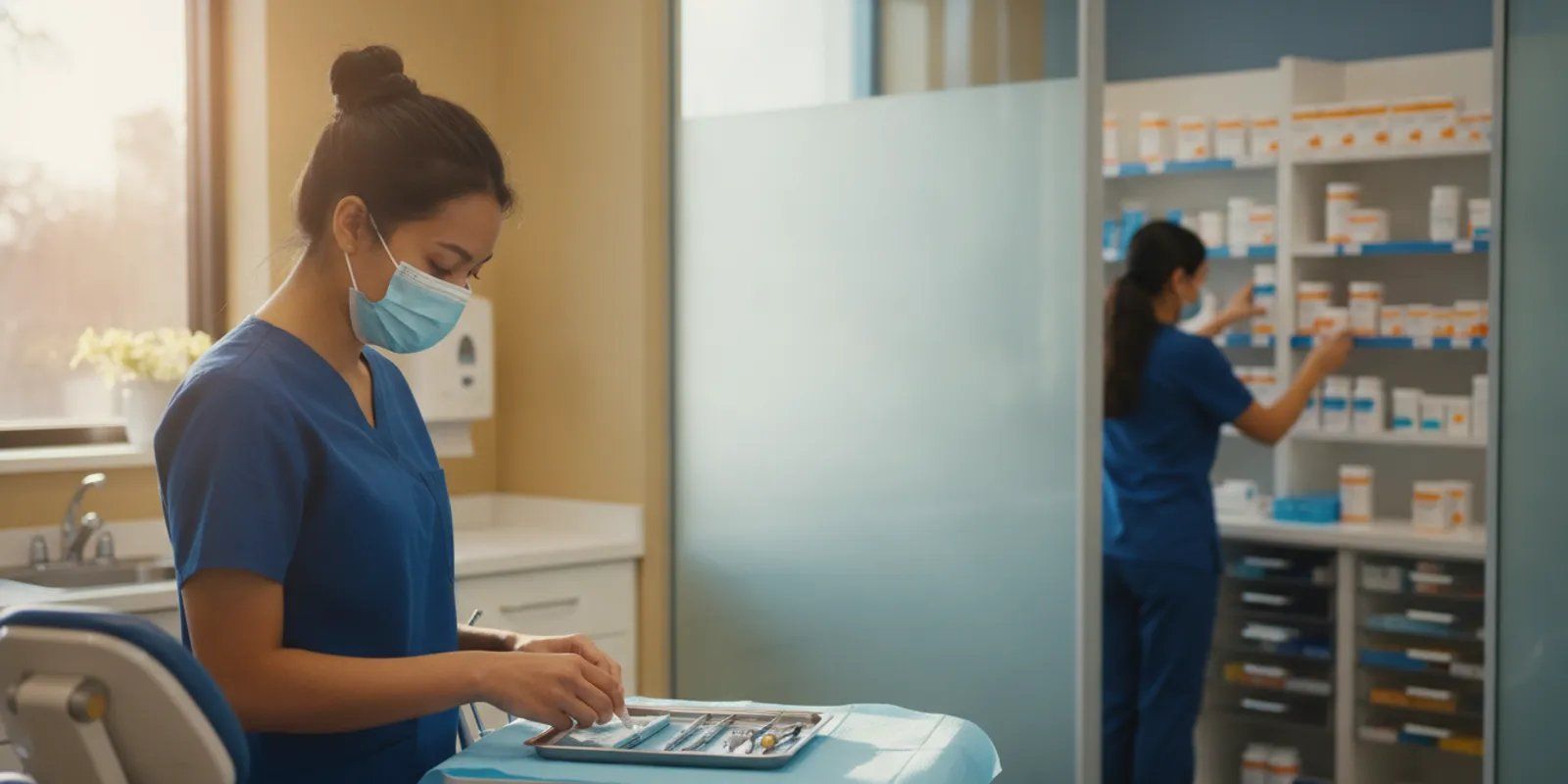
Chairside support is the center of the dental assistant role. The assistant prepares the patient and the work area, passes instruments, uses suction to keep the mouth clear, and keeps the dentist's field usable. The Bureau of Labor Statistics also lists sterilizing instruments, instructing patients on oral hygiene, processing x-rays, keeping treatment records, scheduling, and working with patients on billing.
Those last two items are why the roles can look alike on a job board. A dental assistant may schedule and may talk about a bill. The day is still built around the procedure, not the waiting room.
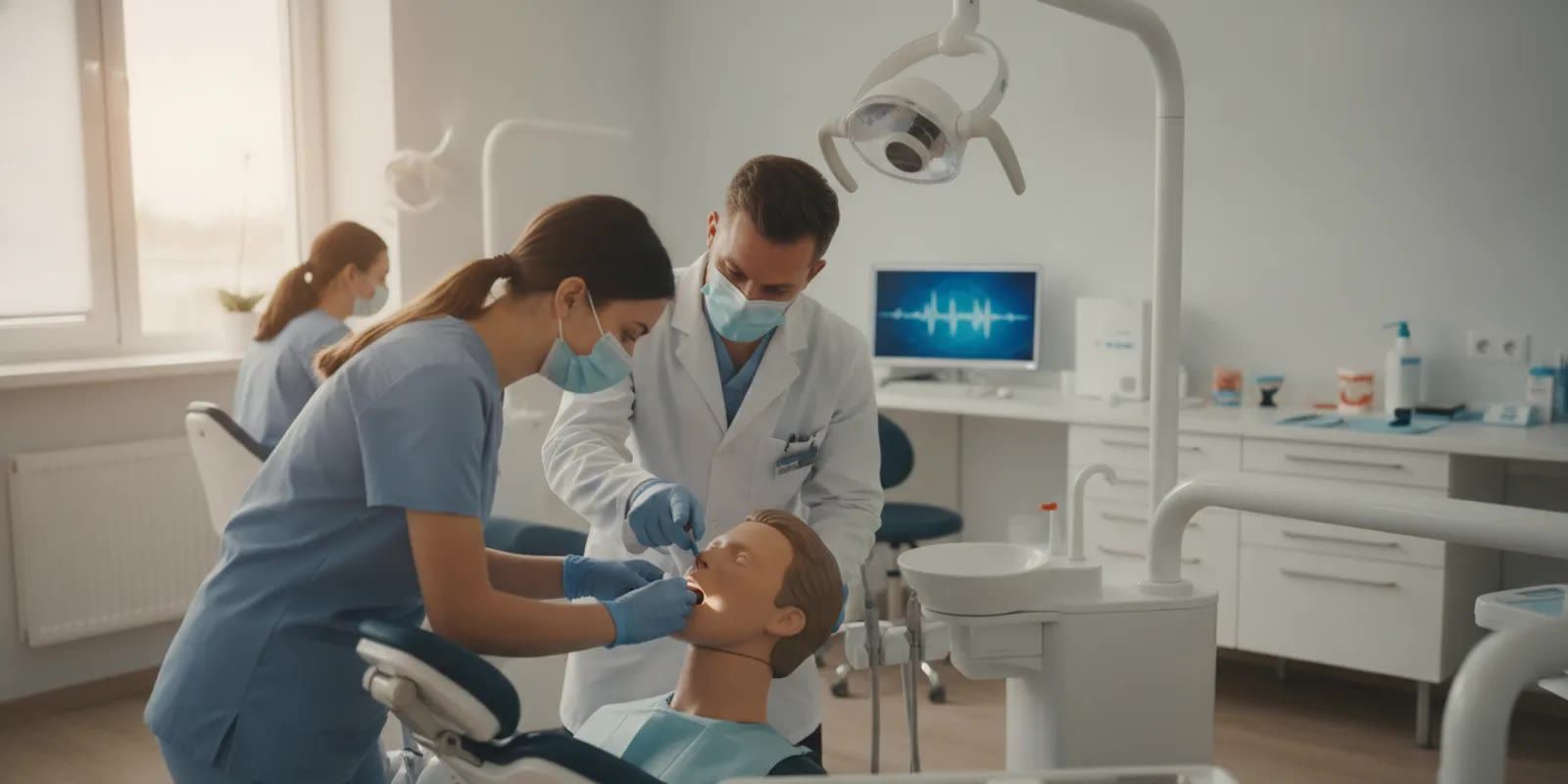
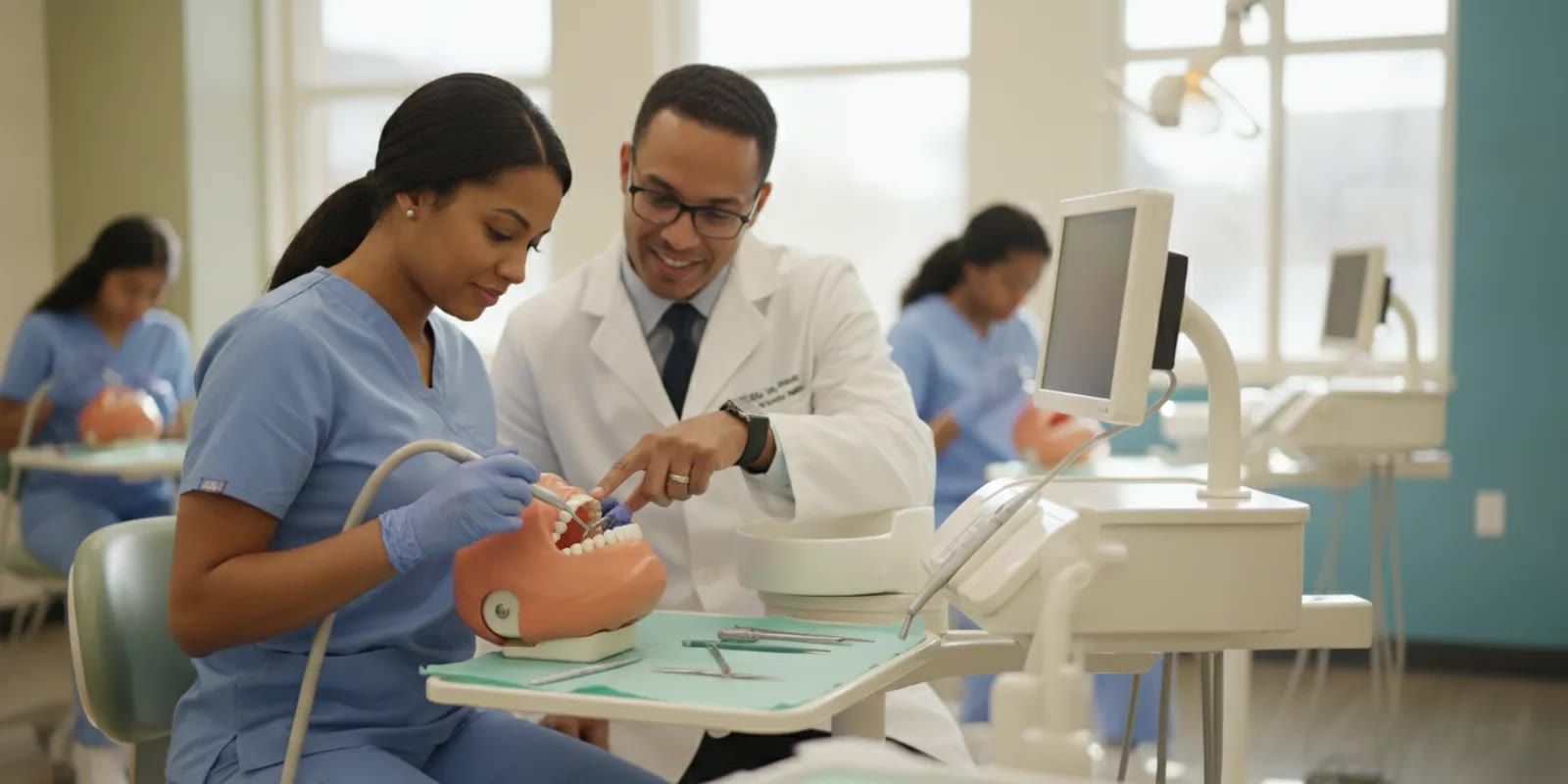
At Alliance Dental Institute, the in-person curriculum covers that chairside work directly. Students practice high- and low-speed suction, rinsing and drying the tooth, and passing instruments. They also study oral anatomy, infection control, dental materials, composite setup, root-canal assisting, and what happens in an emergency visit. The program includes a 40-hour externship in dental offices, assisting with procedures on actual patients. That is practice during training, not a job offer.
The same curriculum teaches sterilization and the autoclave, digital sensors, radiation protection, CPR, and Georgia dental-assistant rules. Those topics belong to the clinical path. They are not the core of a receptionist posting.
Scheduling, charting, and office software
Both roles touch the schedule and the record. The difference is what they type and why.
A receptionist builds and defends the day. They book the visit, confirm it, note a cancellation, and tell the clinical team who is in the chair. A dental assistant uses the chart to record what happened in the procedure and to see what the dentist needs next. Many offices use the same practice-management system for both, so the screen can look similar. The entries are not.
Alliance students learn the basics of Dentrix and Eaglesoft, the two charting programs named in the curriculum overview. That training is for dental charting and notes, not a general front-desk certificate. A receptionist may use the same software for appointments, insurance forms, and account notes. Knowing the program name does not decide the job. The posting's task list does.
If you are comparing roles because you like computers more than clinical work, say that plainly when you tour a school or read a posting. Front-desk software skill is real work. It is a different skill from setting up a tray, exposing a radiograph, or sterilizing instruments.
How Georgia limits the dental assistant role
Georgia does not treat "dental assistant" as a licensed profession you can claim from a job title. Rule 150-9-.01 defines a dental assistant as someone employed in a dental office to assist the dentist. Direct supervision means a Georgia-licensed dentist is in the office, diagnoses the condition, authorizes the procedure. Stays in the facility while it is done, and checks the work before the patient leaves.
Under that rule, some general duties may be delegated only when they are easily reversible and will not raise risk to the patient. Examples include diagnostic impressions, placing and exposing radiographs after the required x-ray training. Removing a periodontal dressing, applying topical anesthetic, and fabricating temporary crowns and bridges outside the mouth. The rule also says a dental assistant may not perform dental hygiene treatment.
Expanded duties are a separate rule. Rule 150-9-.02 says an expanded-duty assistant needs a high school diploma or equivalent, current CPR, and a certificate for the specific duties on that certificate. Only the duties listed on the certificate may be performed, and only under a licensed dentist's direct supervision. Examples on that list include placing sealants, packing retraction cord as the dentist prescribed, and monitoring nitrous oxide after the dentist's instructions. A training program can teach toward those topics. It cannot grant every expanded duty by itself, and it is not a Georgia license.
None of those clinical limits apply to a receptionist who stays at the desk. A receptionist is not authorized to take x-rays or place materials in the mouth because the job is administrative. If a front-desk posting also asks for radiographs, sterilization, or chairside assisting, you are reading a blended role. Ask which tasks are required on day one and which require extra training. Alliance's own guide to expanded functions in Georgia is the place to read that clinical path in more detail.
Side-by-side comparison
Use this table to sort a posting. It compares the usual focus of each role. An office can still ask one person to help with both.
Comparison points
Main workplace. Dental assistant: Treatment room, sterilization, and the clinical chart. Dental receptionist: Front desk, phone, and waiting room.
Core tasks. Dental assistant: Prepare the room, pass instruments, suction, sterilize, and support the dentist. Dental receptionist: Greet patients, answer phones, schedule, and route messages.
Patient communication. Dental assistant: Explain the visit the dentist has authorized and give oral-hygiene instruction. Dental receptionist: Confirm appointments, forms, arrival, and who the patient should see.
Records and software. Dental assistant: Treatment notes and charting, often in Dentrix or Eaglesoft. Dental receptionist: Schedule, intake, insurance forms, and account notes.
Georgia clinical rules. Dental assistant: Direct supervision under Rule 150-9-.01. Expanded duties need the Rule 150-9-.02 certificate. Dental receptionist: No clinical duty list, because the job is not chairside care.
National job family. Dental assistant: Dental assistants, SOC 31-9091. Dental receptionist: Often grouped with medical secretaries, SOC 43-6013.
Employment outlook. Dental assistant: 7% growth, 2025 to 2035, in the BLS Occupational Outlook Handbook. Dental receptionist: 4.8% growth, 2025 to 2035, in the BLS matrix for SOC 43-6013.
Read the percents as national projections, not as a Georgia hiring promise and not as pay. The broad secretary category is the wrong comparison here. That larger group is projected to decline, while medical secretaries and administrative assistants, the family that includes medical receptionists, are projected to grow 4.8% from 2025 to 2035. Dental assistants are a separate occupation, projected to grow 7% over the same 2025 to 2035 window. Do not average those figures or treat either one as your future wage.
The Handbook also puts the May 2025 median wage for dental assistants at $48,070 a year, or $23.11 an hour. The same BLS matrix lists a 2025 median annual wage of $45,930 for medical secretaries and administrative assistants. Those are national medians for whole occupations. They are not Alliance graduate results, and a dental front desk in Villa Rica may pay differently from the national medical-secretary median.
How to choose training for your goal
Start with the work you want to repeat, not with a job title you saw online.
- Circle the tasks you want. If you want instruments, sterilization, radiographs, and the treatment room, look at dental assistant training. If you want phones, the schedule, and insurance forms, look at front-desk experience.
- Read three local postings for each title. Mark every task as clinical, administrative, or both. A mix means the office may cross-train, not that one short course covers both careers.
- Check the supervision words. Georgia clinical tasks name a dentist, direct supervision, or a certificate. A receptionist posting should not require you to work in the mouth.
- Ask what the program actually teaches. For dental assisting, ask about chairside practice, infection control, charting software, radiographs, and the externship. Confirm current dates and cost with admissions.
- Ignore guarantees. No school page can promise a job, a schedule, or a paycheck. Use the national numbers only as context.
Alliance Dental Institute trains dental assistants, not dental receptionists. The program is 12 weeks and fully in-person at one campus, 427 West Bankhead Highway, Villa Rica, GA 30180. The home page says spots for 2027 can be reserved for $275. That figure is a seat reservation, not a published full tuition. The tuition page says the school offers custom payment plans and Meritize financing. Financing still depends on the lender, and it is not proof of cost-free school. Call admissions before you rely on a date or a price.
Students listed on the site are January 9, April 9, July 9, and October 8, 2027. Class hours and end dates are not listed there, so ask. Admissions hours are Monday through Friday, 9 a.m. to 5 p.m. Tours run Monday through Thursday, 8:30 a.m. to 4:30 p.m., with Friday by appointment.
If you are weighing a medical office instead of a dental front desk, that is a different comparison. Read dental assistant vs medical office assistant for the medical-office role. For pay context on the assistant occupation, use how to read Georgia dental assistant pay data rather than a single undated range.
FAQ
Is a dental receptionist the same as a dental assistant?
No. A receptionist runs the front desk: greeting, phones, scheduling, forms, and routing. A dental assistant supports the dentist in the treatment room and handles clinical tasks such as instrument transfer, sterilization, and records of treatment. Georgia even expects assistants to be familiar with appointments and bookkeeping, but the jobs are still distinct.
Can a dental receptionist do chairside work in Georgia?
Only if that person is employed and trained as a dental assistant and works under a licensed dentist's direct supervision. Reception duties alone do not authorize radiographs, temporary crowns, or other delegated clinical tasks. Expanded duties additionally require the education and the specific certificate in Rule 150-9-.02.
Do dental assistants answer phones and schedule patients?
They can. The Bureau of Labor Statistics lists scheduling and billing among dental assistant duties, and Georgia's general-duty rule mentions appointments and bookkeeping. In many offices the receptionist still owns the waiting room and the main phone, while the assistant charts the procedure and supports the dentist.
Does Alliance Dental Institute train dental receptionists?
No. Alliance trains dental assistants at its Villa Rica campus. Course topics include chairside assisting, sterilization, radiography, Dentrix and Eaglesoft charting, dental materials, CPR, Georgia rules, and a 40-hour externship. Front-desk skills may overlap, but the program is not a receptionist course.
Which role needs a training program?
Receptionist postings often ask for a high school diploma and office-software comfort, with duties learned on the job. Dental assisting has several paths nationally. Some states require a program and an exam, and others allow on-the-job training. In Georgia, radiographs and expanded duties have their own training rules, so a clinical path needs more than a desk orientation. Compare programs, then confirm the current offer with the school.
Start an admissions account if you want the dental assistant path, or call (470) 801-4234 to ask whether the 12-week program matches your goal.